

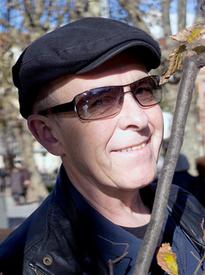
 British author Ian Watson, who "established his reputation as an exhilarating, intellectually adventurous writer of science fiction" with his first novel, The Embedding (1973), winner of the Prix Apollo in France, died April 13, the Guardian reported. He was 82. Watson's debut novel was followed by The Jonah Kit (1975), winner of the British Science Fiction Association award, and The Martian Inca (1977).
"As can happen with genre writers who do not stick to a formula, he did not achieve great commercial success or critical acclaim, but did maintain a long career, writing what he wanted. His early books are now sci-fi classics, kept alive as e-books, but some of his later, out-of-print novels are ripe for rediscovery," the Guardian wrote. Author Adam Roberts pointed to the "intricate interweaving of myth and science" in Watson's The Books of Mana, inspired by the Finnish epic, the Kalevala.
Although Watson published more than 20 novels, after 2001 he concentrated on short stories. Altogether he published 15 collections, including The Very Slow Time Machine (1979) and The 1000-Year Reich (2016).
Watson's "reputation as an ideas man brought him to the attention of Stanley Kubrick, who was looking for a writer to help him develop the Brian Aldiss short story 'Super-Toys Last All Summer Long' into a feature film," the Guardian noted. For nine months in the early 1990s, Watson was paid to be personal writer, conversational partner, and muse to Kubrick. The resulting film, AI Artificial Intelligence (2001), was ultimately made by Steven Spielberg, with a screen credit for Watson.
During the late 1990s Watson became the primary caregiver for his ill wife and wrote poems, which he described as "like condensed short stories." One of them, "True Love," won the 2002 Rhysling award from the Science Fiction Poetry Association. After his wife's death in 2001, he resumed writing short fiction.
The European Science Fiction Society gave him the title of European Grandmaster in 2024, "and he was writing to the end, leaving behind an unfinished story about Nietzsche in Turin, and still more ideas," the Guardian noted. Although dedicated to his craft, he insisted that "writing should be fun."